Playwright is one option to the question how do I drive a real browser reliably? — fast, cross-browser, auto-waiting, with a trace viewer that makes failures legible. What it doesn't solve is the expensive part: someone still has to write every locator, every assertion, and every wait, and then keep them all alive as the app underneath them changes. Playwright AI is the name for closing that gap — using an AI agent to generate, run, and repair Playwright tests instead of hand-coding and hand-patching each one.
The phrase covers a lot of half-built ideas right now, from "ask ChatGPT for a spec file" to full agentic pipelines. This post draws the line between them: what Playwright AI actually means, how the generation loop works when it's done properly, what "self-healing" is and isn't, and where the approach fits in a real 2026 test strategy.
What "Playwright AI" actually means
Start with what it is not. Pasting your app's description into a chat window and getting a .feature file back is not Playwright AI in any useful sense — it's autocomplete with extra steps. The model has never seen your app; it pattern-matches on what login forms usually look like and hands you code that compiles and then fails on the first real run. A test you didn't run is a liability no matter who wrote it, and a generated one you didn't run is the most dangerous kind, because it looks finished.
Playwright AI, done right, means two things:
- AI is used at authoring and repair time — not at run time. An agent writes the Playwright code and fixes it when it breaks. But the artifact it produces is saved Playwright code. Ordinary specs do not need the generation model; optional AI plugins and triage have separate dependencies and hosted execution uses credits.
- The code is grounded in your real, running application. The agent opens your actual site, finds your actual buttons and labels, and verifies what it wrote against the live page before it ever reports success.
Keep those two properties and you get the leverage of AI without giving up the thing that made Playwright worth using: a test that does the same thing every time.
Why AI, and why now: the maintenance tax
The case for Playwright AI isn't "writing tests is hard." Writing the first version of a test was never the bottleneck. The bottleneck is that a suite is a liability you pay down every sprint — a renamed button here, a restructured DOM there, and a dozen specs go red for reasons that have nothing to do with a real bug. Some teams find maintenance more costly than initial authoring, which is the actual cost of test maintenance that never shows up in the estimate.
That tax is why coverage stalls. When every new flow adds permanent maintenance debt, the rational move is to test the happy path and skip the edge cases — which is exactly backwards, because the edge cases are where incidents live. Playwright AI changes the arithmetic: if creating a test is a sentence and repairing it is a regeneration, the cost of an extra scenario drops far enough that broad coverage becomes affordable again. And it attacks flakiness at the root, because test authoring can contribute to flakiness — bad waits, brittle selectors, order dependence — patterns a generator should aim for and a reviewer should check.
How Playwright AI works, end to end
The interesting part is the loop between "I described a flow" and "a verified test exists." Here's what a real pipeline does, using how TestVibe generates tests as the worked example.
1. Describe the behavior, not the implementation
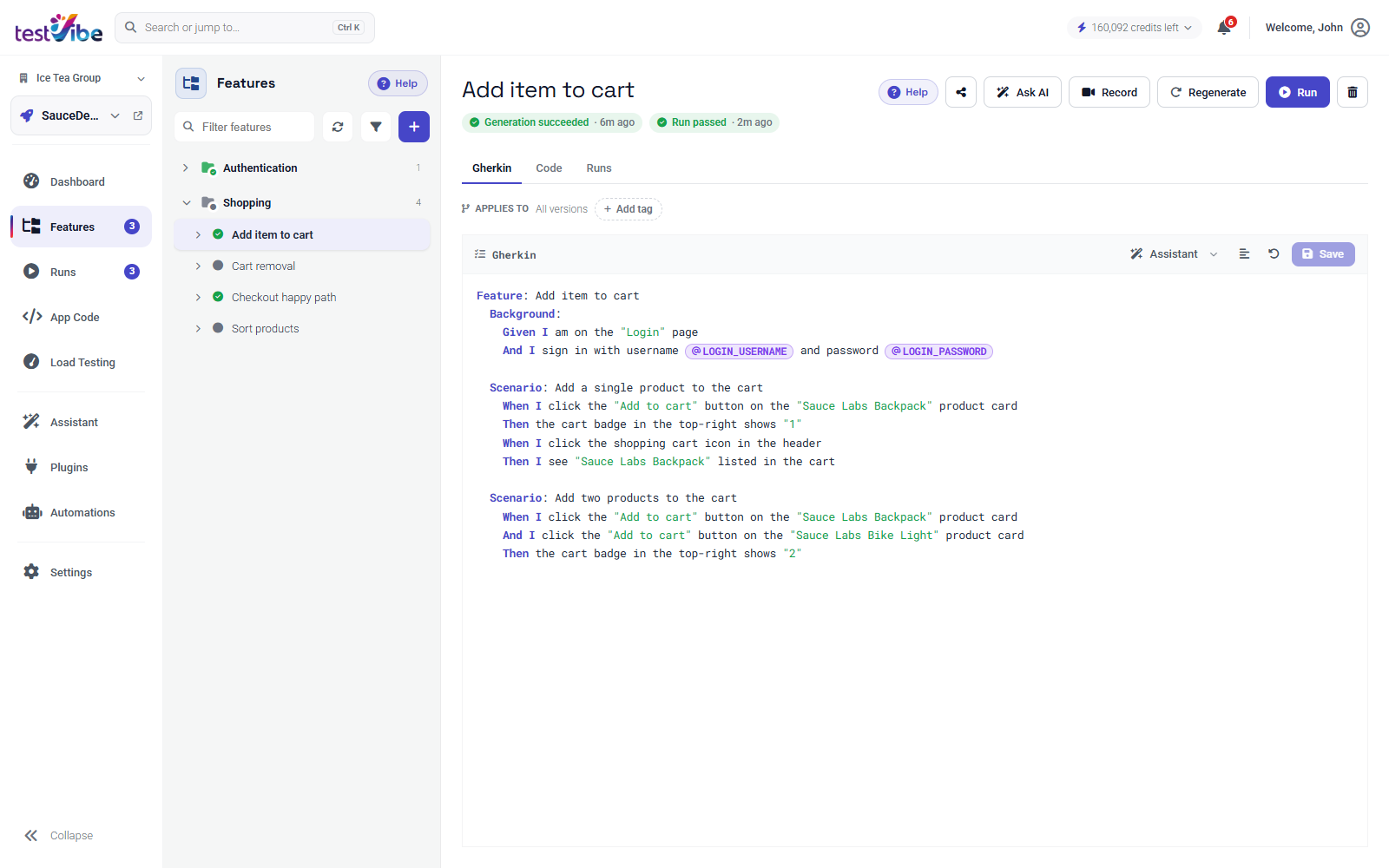
You start in plain English: a returning customer removes an item from the cart and sees the subtotal drop. That intent becomes a Gherkin .feature file — a readable Given / When / Then spec that names the actor, the action, and the visible outcome that proves success. Gherkin matters here for a specific reason: it stores intent separately from code, which is what makes both review and self-healing possible later. (If you're skeptical that BDD earns its keep, we make the case for Gherkin as generation input rather than team ceremony.)
The quality bar on your description is lower than you'd fear but not zero — writing a good test description is mostly naming the visible thing that proves the flow worked, not clicking around and asserting nothing.
2. The agent writes code against your real app
This is the step that separates generation from autocomplete. The agent spins up an isolated browser session, opens your live application, and explores the flow the spec describes — finding the real controls, the real labels, the real timing quirks — before committing to a line of code. Then it writes the Playwright, runs it against the live page, and attempts corrections within its budget; inspect the final outcome.
Because it's grounded in reality, the output has the properties you'd want in review anyway: resilient, role-and-name locators that survive a CSS refactor instead of brittle generated IDs, and web-first assertions — Playwright's auto-retrying expect matchers — instead of a snapshot-in-time boolean that passes or fails on timing luck.
3. Run it deterministically — and regenerate when the UI changes
Once generated, running is just Playwright: fast, cheap, repeatable. And when the "Save" button becomes "Save changes" six weeks later and the test goes red, you don't hand-patch a selector. You confirm whether the behavior changed, adjust the Gherkin if it did, and regenerate — the agent re-explores the current app and produces fresh, re-verified code. The spec is the durable asset; the code is disposable.
What "self-healing" really means (and doesn't)
"Self-healing" gets used loosely enough to be a red flag, so it's worth being precise. A self-healing test is not a test that ignores failures — it's one whose intent lives separately from its implementation, so the framework always knows what the test was supposed to prove.
That separation is the whole trick. When a locator breaks, there are two possibilities, and they must be told apart:
- The app changed on purpose — a redesigned checkout button, a restructured menu. Here the AI re-derives a working path from the unchanged intent and updates the code. Review the changed test and its expectations.
- The app actually broke — the button is gone, the flow is dead. Here the test must fail, loudly, because that's a real regression.
An unexplained failure alone cannot distinguish those cases, whether the test was generated or hand-written: a moved element and a genuine bug both surface as the same red X, which is why teams learn to distrust their own suites. Self-healing done right is precisely the ability to heal the first case while failing the second — not a promise that tests never break.
Beyond generation: the same intent, reused
Once a flow is described, generation is only the first thing you can do with it. The same plain-English journeys drive the rest of a quality program:
- Load testing. Replay a feature as concurrent browser-based virtual users, or drive protocol-level k6 traffic with ramp stages and threshold gates — the flow you already test becomes the flow you stress.
- Live telemetry. While the load runs, watch your servers stream CPU, memory, GC, and custom metrics, so a failed assertion connects directly to what the backend was doing when it failed.
- Terminal and agent surfaces. Everything runs from a CLI and an MCP server, so your CI and your coding agents can generate and run tests without a browser tab — and the whole platform can be self-hosted for teams that need code and data to stay in-network.
Playwright AI vs. hand-written Playwright
The point isn't to replace Playwright. It's real Playwright the whole way down — the AI just removes the two costs that kept good teams from the coverage they wanted.
| Hand-written Playwright | Playwright AI | |
|---|---|---|
| Authoring a flow | Write and review code | Describe, generate and review |
| When the UI changes | Manual selector surgery | Regenerate from intent |
| Who can read the test | Engineers | Engineers, QA, and PMs (Gherkin) |
| Cost per run | Framework is open source; infrastructure has costs | Hosted credits or self-hosted infrastructure/provider costs |
| Coverage growth | Bottlenecked by author time | Scales with description |
Where Playwright AI fits in a 2026 test strategy
Playwright AI doesn't change what you should test — it changes what's affordable to test. End-to-end tests still carry the most weight because they verify behavior the way a user experiences it, which is why E2E anchors a 2026 test strategy even as unit and integration layers stay useful. What changes is that the expensive tier finally scales: you can afford the breadth of end-to-end coverage you always wanted because authoring and upkeep stopped being manual.
It also settles the perennial engine question in passing. If tests are generated and regenerated for you, the runner underneath should be one that meets your browser and operational needs — which is a large part of why Playwright wins over Selenium and Cypress as the execution layer. Playwright AI is that engine plus an author that never gets bored.
Getting started
The shortest path to seeing this on your own app is to describe one real flow — a login, a checkout, a form submission — and let the agent generate a verified Playwright test for it against your live site. From there the same description powers load tests and telemetry, and review and regenerate when the app changes.
Want tests you can describe, review and regenerate — real Playwright you can read, grounded in your actual app? Get early access, or read exactly how the generation pipeline works and why the tests come out green.